Performance & Care Guide
Does Taj Mahal quartzite etch or stain? Acid, oil, heat and sealing explained
Short answer: a genuine quartz-dominant Taj Mahal slab does not etch the way marble does, because it is not calcite-based. It can still mark, and the reason is usually porosity or a resin fill rather than the stone itself. Here is what actually happens on a countertop.
Does Taj Mahal quartzite etch or stain? Real Taj Mahal quartzite is a metamorphic stone dominated by quartz, not calcium carbonate, so household acids such as lemon juice or vinegar do not dissolve it the way they dissolve marble or a marble-look surface. In normal kitchen use it will not develop the white acid ring that owners of white marble complain about. It can, however, take a stain if a pigmented liquid sits long enough on an unsealed face, an open fissure or a resin-filled area, and a strong acid left standing can dull a high polish. That distinction — etching is chemistry, staining is absorption — is the whole topic in one sentence.
This page covers the behaviour of the surface itself. If you are still deciding between quarried and manufactured material, read the quartzite vs quartz comparison first, then come back here for the care side.
1. Why etching and staining are two different problems
Etching is a chemical reaction. Acid meets calcium carbonate and eats a shallow, dull pit into the surface. Marble, limestone and onyx are carbonate stones, which is why a slice of lemon left on a marble island overnight leaves a permanent matte footprint. Quartzite is sandstone that has been metamorphosed — its framework is silica, and silica is not attacked by weak food acids. That is the structural reason Taj Mahal quartzite holds up where marble does not.
Staining is physical. A liquid enters the pore structure, or a resin fill, before it evaporates, and the pigment stays behind. A dense, well-finished slab absorbs very little. An open fissure that has been filled at the factory, a cut-out edge that was never sealed, or a honed face with more exposed surface can absorb more. Neither failure mode is unique to this stone, but they need different prevention, so it helps to know which one you are actually worried about.
2. What each common substance really does
The table below is practical guidance based on how the surface behaves, not a laboratory test report. Because natural stone varies from block to block, treat it as a risk ranking and confirm anything critical on an offcut from your own bundle.
| Exposure | Polished natural Taj Mahal quartzite | Honed / leathered quartzite | Engineered Taj Mahal quartz |
|---|---|---|---|
| Lemon juice, vinegar, wine, tomato | Low risk of etching; wipe up standing acid rather than leaving it overnight | Low risk of etching; slightly more surface to absorb colour | Low risk of etching; resin binder is not calcite-based either |
| Cooking oil, butter, olive oil | Low risk when sealed; a long-standing pool can darken an absorbent area | Moderate risk before sealing, because a honed face is more open | Low risk; non-porous surface resists oil |
| Turmeric, beetroot, red wine reduction | Wipe promptly; pigment is the usual cause of a visible mark | Higher risk on unsealed honed material | Low risk; wipe promptly on light colours anyway |
| Hot pan straight off the hob | Thermal shock can craze a resin fill; always use a trivet | Same, and more visible on a matte face | Highest risk of the three — resin scorches and discolours |
| Bleach, acetone, strong solvents | Rinse after contact; prolonged contact can dull a polish | Avoid solvent pooling on sealed faces | Avoid — solvents attack the resin matrix |
| Limescale and hard water | Wipe dry; descale with a pH-neutral stone cleaner, not an acid gel | Same, matte faces show drying spots sooner | Same; avoid abrasive pads |
The single most useful habit is not a product. It is wiping a spill instead of letting it dry, and using a trivet. Those two habits prevent most of the marks that get blamed on the stone.
3. Where staining actually comes from on a real slab
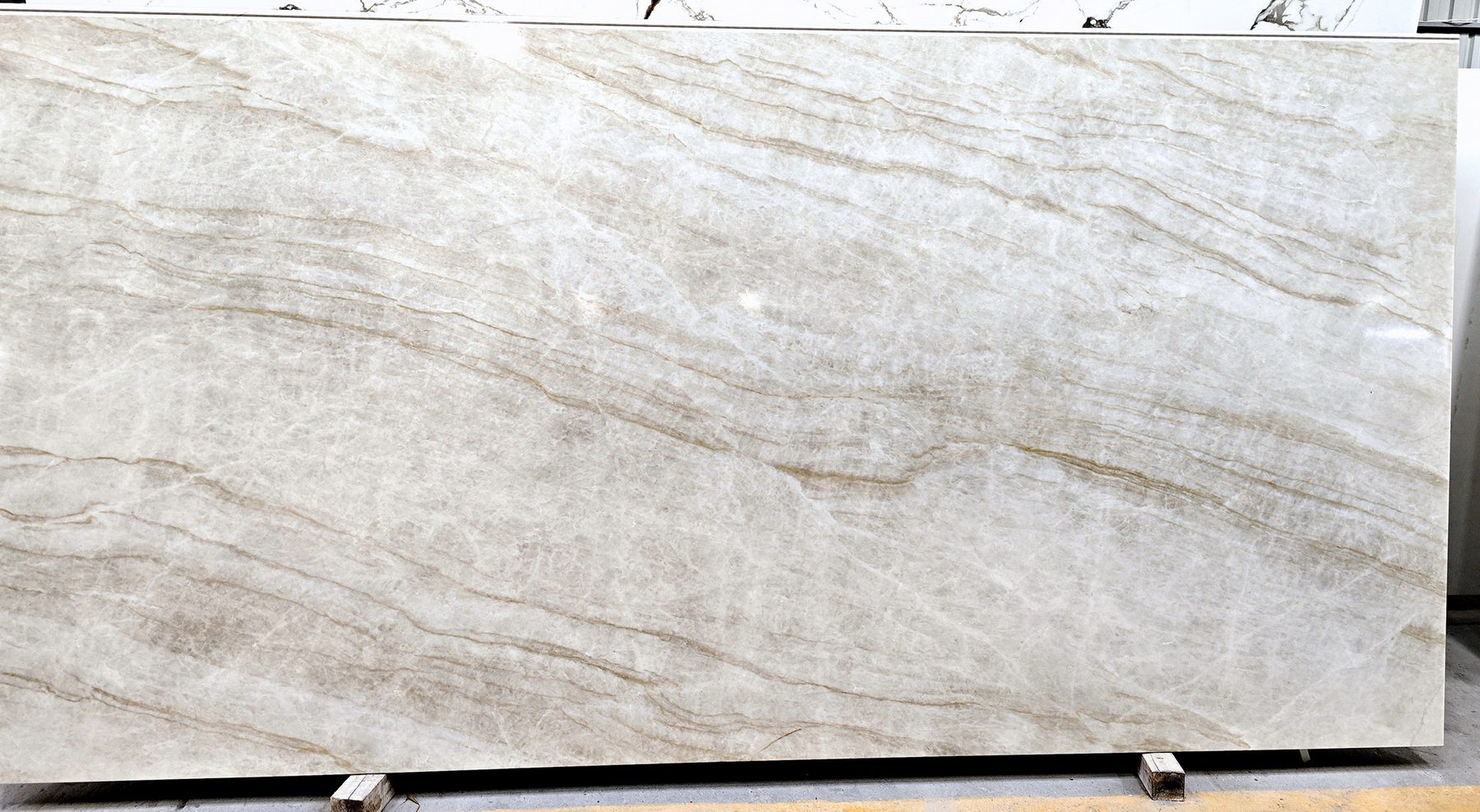
On a production line the vulnerable points are predictable, and they are visible on the slab before it ever reaches a kitchen. Natural Taj Mahal quartzite arrives in bundles of roughly 3300 × 2000 mm slabs in 2cm or 3cm, and dimensions vary by block and bundle, so each slab is assessed as an individual face rather than as a repeatable SKU. Fissures that need stabilising are filled, and the fill is where absorption can concentrate if the finish and the sealing are not handled properly.
Ask for the actual bundle photographs, not a library image. Our slab catalogue lists photographed bundles with bundle codes, and the inspection record describes what is checked on the face, the edges and the fill before loading. If a specific bundle has a heavier fill line and it is going into a wet area, that is a decision you should make with the photo in front of you.
4. Does Taj Mahal quartzite need sealing?
Sealing is cheap insurance, not a permanent coating. An impregnating sealer lines the pore structure and slows absorption; it does not make stone waterproof, it does not stop acid chemistry, and it does not repair a dull spot. For most residential kitchens a penetrating sealer at installation, refreshed when water stops beading on the surface, is enough. Polished faces absorb slowly and can often go longer between treatments than honed ones.
| Application | Typical specification | Sealing approach | Why |
|---|---|---|---|
| Kitchen worktop and island | 2cm or 3cm, polished | Seal at installation, re-check annually | Oil and pigment contact is frequent; polished faces shed liquid well |
| Bathroom vanity top | 2cm, polished or honed | Seal at installation, and seal cut-outs and edges | Soap, cosmetics and dye are the usual staining agents |
| Full-height backsplash | 2cm, polished or honed | Seal once; little abrasion in service | Vertical surface, minimal pooling |
| Outdoor or semi-outdoor kitchen | 3cm preferred | Seal and re-seal on a shorter cycle | Rain, UV and temperature cycling accelerate absorption |
Whatever the sealer, test it on an offcut first, and never seal over a damp slab. Trapped moisture under a sealer is a far more common defect than an unsealed countertop.
5. Engineered Taj Mahal quartz behaves differently
Engineered quartz is a different material with different failure modes, and it is worth being precise about it. The slab is roughly nine parts ground quartz to one part resin binder, pressed in fixed formats — Jumbo 3200 × 1600 mm or Super Jumbo 3500 × 2000 mm, in 2cm or 3cm. Because the surface is non-porous, staining is rarely the issue. Heat and solvents are. A hot pan can scorch the resin and leave a permanent pale mark, and strong solvents can attack the binder. The trade-off is consistency: across hundreds of identical tops in a hotel or multifamily program there is no block-to-block variation, which is exactly why those projects specify it.
Practical split for specifiers: choose natural Taj Mahal quartzite where movement, depth of colour and one-off statement surfaces matter, and engineered Taj Mahal quartz where you need repeatable colour across many units. Both are produced on our four lines across Shuitou Town in China and Rayong in Thailand, and both can travel together in one container to meet the 1 × 20ft container minimum.
6. Test your own bundle before fabrication
You do not need a laboratory to know how your slab will behave. On an offcut from the actual bundle:
- Water bead test. Place a few drops on the face. If they stay as beads and do not darken the stone within a minute, absorption is low and sealing is optional but still sensible.
- Oil test. A drop of cooking oil left for an hour on an unsealed offcut will show you how much a spill could darken that particular slab.
- Acid test. A drop of vinegar on a polished offcut, wiped after a few minutes, will confirm whether the face dulls. If it does, treat the material as carbonate-bearing and specify accordingly.
- Fill inspection. Look along the filled fissure lines under raking light. Heavy fill in a wet-area piece is a reason to choose a different slab.
Do this before the template is made, not after. It takes ten minutes and it settles the specification conversation with your client.
Etching and staining FAQ
Will Taj Mahal quartzite etch from lemon juice or vinegar?
Genuine quartz-dominant quartzite resists weak food acids far better than marble, so a wiped-up splash is unlikely to leave a mark. Standing acid left on a polished face for hours, or acid on a resin-filled area, can dull it. Wipe and rinse rather than letting it dry.
Can Taj Mahal quartzite be stained permanently?
Most surface marks are pigment sitting in the top layer and lift with a pH-neutral stone poultice. Deep absorption into an unsealed fissure is harder to reverse. Sealing at installation, and sealing cut-outs and edges, is what keeps the risk low.
Is sealing mandatory before installation?
Not mandatory, but recommended for kitchens, vanities and anything outdoors. Polished faces absorb slowly; honed and leathered faces benefit more. Seal on a dry slab, and re-seal when water stops beading rather than on a fixed calendar.
Specify from the bundle you will actually receive. Send the application, thickness (2cm or 3cm) and finish you need, and we will reply with available bundles, face photographs with bundle codes, and a container price for a single 20ft load. Message WhatsApp +86 130 5543 1394 or email mark@quanstone.com. The slab catalogue is the fastest place to start.