Design and fabrication guide
Bookmatched Taj Mahal quartzite slabs for islands and feature walls
Use a clear slab-selection brief to coordinate vein direction, thickness, finish and the actual bundle before fabrication or a factory-direct shipment.
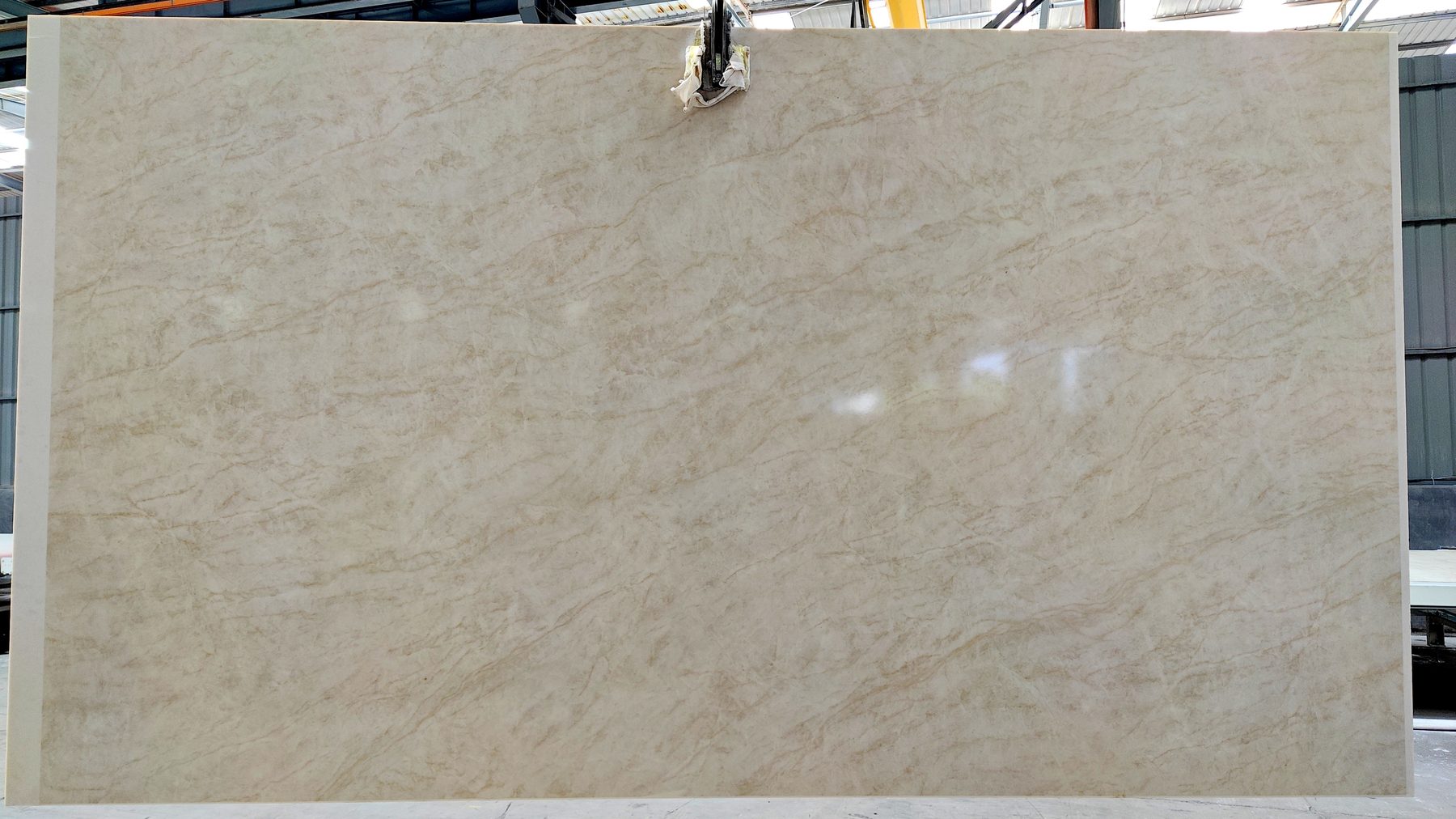
Bookmatched Taj Mahal quartzite is selected by the way adjacent slabs work together, not by a product name alone. For a kitchen island, full-height backsplash or feature wall, the fabricator needs the actual slab sequence, the intended seam position and the direction of the natural movement. A current full-slab photo or video of the approved bundle is more useful than a generic sample image.
This guide covers natural Taj Mahal quartzite slabs. If your project needs repeatable dimensions and more uniform production, compare the available engineered Taj Mahal quartz slabs before finalizing the cut plan.
What to confirm before requesting a bookmatched pair
| Selection item | What to specify | Why it matters |
|---|---|---|
| Application | Island waterfall, backsplash, wall panel, vanity or another cut plan | Determines slab orientation, seam visibility and expected yield |
| Vein direction | Preferred flow, focal area and whether the pair should mirror across a seam | Helps the factory and fabricator judge continuity from the actual slabs |
| Slab format | Natural slabs are approximately 3300 x 2000 mm; confirm the actual bundle | Sets the available cutting envelope and layout options |
| Thickness | 2cm or 3cm, including any built-up edge detail | Changes support, edge fabrication and container weight |
| Finish | Polished, honed or leathered, as required by the design | Changes how the background and movement read under light |
Bookmatching starts with the full slab, not a small crop
Ask for a full view of each slab in the proposed sequence. The image should show the complete length and width, with the slab code or bundle reference visible where practical. Review the pair side by side and identify the seam that will become the visual centreline. A close crop can make two slabs appear compatible while hiding a change in background tone, a vein break or an edge condition.
Match the layout to the project
For a waterfall island, the visible top, return and end panel should be discussed together. For a feature wall, establish the centreline and panel sequence before cutting. For a backsplash, confirm the height, outlet cut-outs, hood area and seam locations. Strong movement can be a useful focal point, but only when the placement is intentional and the actual slabs support the design.
| Project type | Useful approval information | Common risk to avoid |
|---|---|---|
| Waterfall island | Island dimensions, overhang, end-panel direction, sink and cooktop cut-outs | Approving a pair without checking the return-panel yield |
| Full-height backsplash | Wall length, height, outlet positions, hood opening and seam plan | Choosing a crop that does not show the full vertical movement |
| Feature wall | Centreline, panel order, lighting conditions and visible edges | Assuming every adjacent slab has identical background tone |
| Vanity top | Basin cut-out, splash detail, edge profile and required thickness | Ignoring support and edge construction while focusing only on the pattern |
Natural quartzite or engineered Taj Mahal quartz?
Natural quartzite gives each approved bundle its own background and vein movement. That variation is often the reason a designer chooses it for a feature application. Engineered quartz is a practical alternative when a project prioritizes repeatable slab formats and a consistent manufactured pattern. Engineered formats available from the factory include Jumbo 3200 x 1600 mm and Super Jumbo 3500 x 2000 mm; confirm the required format and current stock with the quotation.
Both material decisions should be made against the real cut plan. Use the Taj Mahal slab catalogue to identify the material family, then request current photos and video of the specific available bundle or batch.
Factory-direct approval checklist
- Send the application, finished dimensions, cut-outs, preferred vein direction and required thickness.
- Ask for full-slab images of the actual natural bundle, or batch information for engineered quartz.
- Confirm the slab sequence, finish, visible filled areas, edge condition and any acceptable variation in writing.
- Approve the packing and loading plan before the shipment is sealed. The standard minimum is one 20ft container, with mixed loading subject to the actual arrangement.
Our production bases in Shuitou, China and Rayong, Thailand operate four production lines for cutting, finishing, inspection and export packing. See the factory profile when preparing a sourcing brief, and include the destination port if you need a current container quotation.
FAQ
Does bookmatching mean the slabs are identical?
No. Bookmatching describes a planned relationship between adjacent slabs. Natural stone still varies in background, vein density and structure, so approve the actual pair and sequence rather than relying on the name of the stone.
Is 2cm or 3cm better for a bookmatched island?
That depends on the support system, edge construction and design brief. Specify 2cm or 3cm before the bundle is approved, and have the fabricator confirm the edge and overhang details.
Can I select a bookmatched pair from a catalogue image?
A catalogue is useful for identifying the material family, but it is not a substitute for current full-slab photos and video of the available bundle. Request those records before confirming the order.
Need a bookmatched Taj Mahal slab review? Send the application, cut plan, preferred vein movement, thickness, finish and destination port. Message us on WhatsApp at +86 130 5543 1394 or email mark@quanstone.com.