Natural stone buying guide
How to grade Taj Mahal quartzite slabs: background, veining and bundles
Compare the visual and practical details that matter when selecting a natural Taj Mahal quartzite bundle for a countertop, island or feature wall.
There is no universal online grade that can replace looking at the actual slabs. Natural Taj Mahal quartzite varies from bundle to bundle, so a buyer should compare the background, vein movement, structural condition, dimensions and finished surface together. The safest factory-direct process is to request photographs and video of the specific bundle before approving shipment.
This guide is for buyers sourcing natural Taj Mahal quartzite slabs. It explains what to record in a purchase brief without inventing a fixed price or treating a stock image as proof of the material that will ship.
Five points to compare in a Taj Mahal quartzite bundle
| Inspection point | What to look for | Why it matters |
|---|---|---|
| Background | Warm white to cream base, with the degree of grey, taupe or gold movement noted from the actual slabs | Sets the overall appearance and affects whether the bundle fits the design brief |
| Veining | Direction, density, contrast and continuity across adjacent slabs | Helps the fabricator plan an island, splashback or book-matched feature |
| Slab format | Approximately 3300 x 2000 mm for natural slabs; confirm the actual bundle | Determines layout, yield, seams and freight planning |
| Thickness | 2cm or 3cm, as specified for the project | Changes edge details, support requirements and container weight |
| Surface and condition | Polished, honed or leathered finish; review resin-filled areas, edges, flatness and visible damage | Connects the visual selection to fabrication risk and the final application |
Background tone and movement
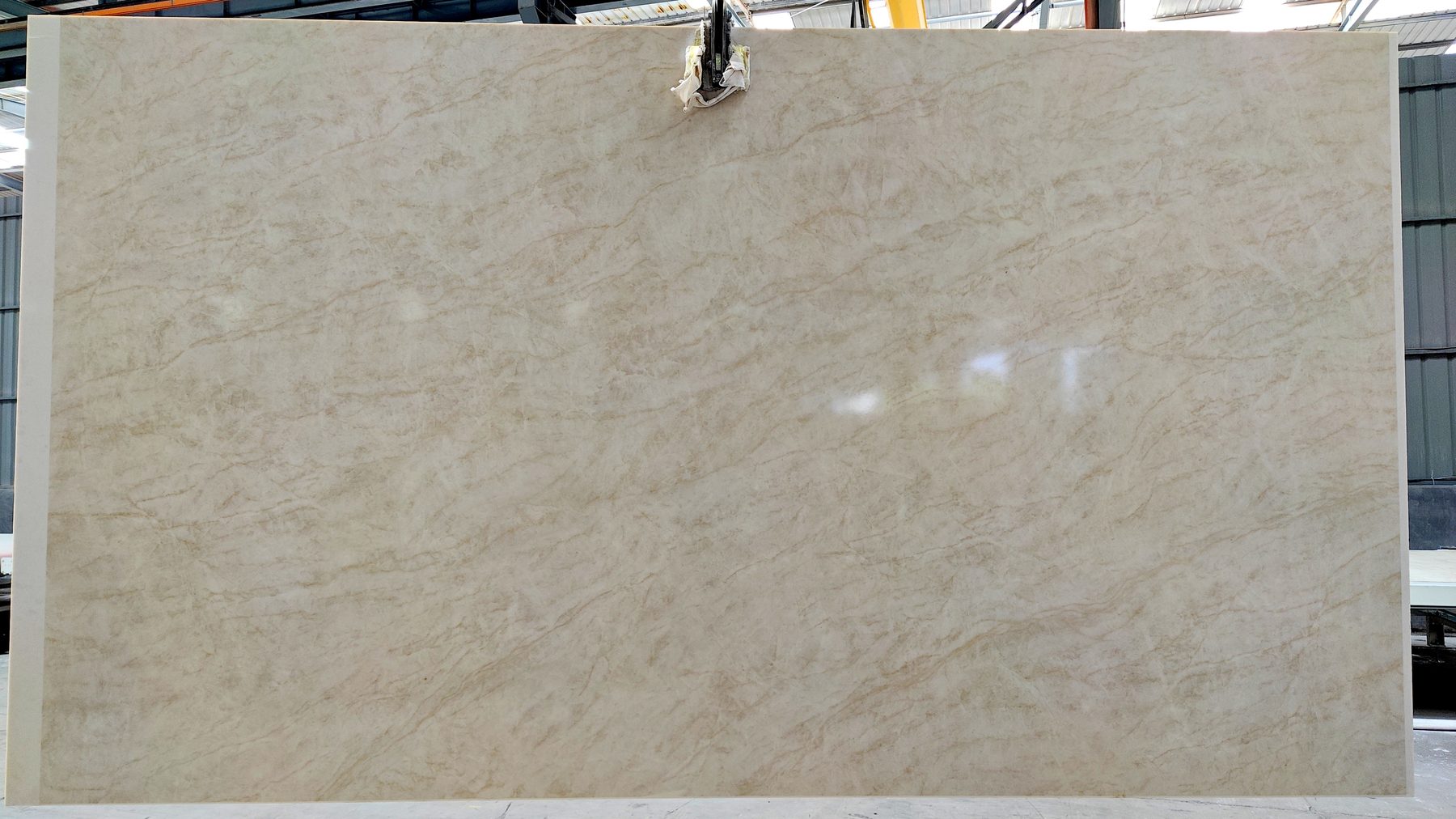
Start with the base colour before judging the veins. A bundle can read cleaner and warmer than another bundle even when both are sold under the Taj Mahal name. Record the background as it appears in the full-slab photographs, then note whether the movement is fine and distributed or concentrated in broad bands. Avoid making a decision from a small crop: the full composition is what the fabricator must place on an island or wall.
Natural variation is not a manufacturing defect by itself. The important step is to decide whether the variation is acceptable for the intended layout, and to approve the actual bundle rather than an unrelated marketing photograph.
Vein direction, continuity and book-matching
For a waterfall island or full-height backsplash, ask how adjacent slabs will be placed. Veins that run in a compatible direction can create a calmer layout; strong movement may be intentionally positioned as the focal point. If a book-matched pair is required, specify it before the bundle is selected so the factory can confirm whether the actual slabs support that layout.
Send the fabricator a simple cut plan showing the island length, overhang, sink and cooktop cut-outs, splashback height and preferred vein direction. This makes it easier to judge yield than a generic request for “high grade” stone.
Thickness and finish are part of the grade decision
Natural Taj Mahal quartzite is available in 2cm and 3cm formats. The right choice depends on the application and edge construction, not on appearance alone. Polished, honed and leathered finishes also change how the background and veins are perceived under light. Include both thickness and finish in the bundle approval message.
| Project question | Information to confirm |
|---|---|
| Kitchen island | 3cm or the specified edge build-up, overhang support, cut plan and vein direction |
| Vanity or wall application | Whether 2cm is suitable for the support system, plus finish and seam locations |
| Feature wall or book-match | Pair availability, slab sequence, dimensions and full-slab photographs |
| Wholesale shipment | Bundle photos, thickness, finish, quantity, destination and the 1 x 20ft container loading plan |
How to approve an actual bundle online
- Choose the application and write down the required thickness, finish and approximate cut sizes.
- Review the Taj Mahal slab catalogue, then request current full-slab photographs and video of the available bundle.
- Ask the factory to identify the slabs in the images and explain any visible filled areas, edge marks or variation.
- Confirm the final bundle, packing plan and trade terms in writing before the container is sealed.
Our production bases in Shuitou, China and Rayong, Thailand operate four production lines for cutting, finishing, inspection and export packing. See the factory profile for the production and inspection process. The factory minimum is one 20ft container, and mixed orders can be planned subject to the actual loading arrangement.
FAQ
Is a cleaner background always a higher grade?
Not necessarily. Grade should match the project brief. A buyer may prefer a calm background for a large repeat programme or stronger movement for a feature island. Compare the actual bundle, application and yield together.
Can I judge a bundle from one slab photograph?
One photograph is not enough for a confident approval. Request full-slab views, adjacent slabs where relevant, visible condition details and video of the specific bundle.
Does the same grade have a fixed factory price?
No. A quotation depends on the actual bundle, thickness, finish, quantity, trade term and destination. Request a current quote against the approved stock rather than relying on an unverified fixed price.
Need to approve a real Taj Mahal quartzite bundle? Send your application, preferred background and vein movement, thickness, finish and destination port. Message us on WhatsApp at +86 130 5543 1394 or email mark@quanstone.com.